Chicagoland Judges andFriends Buenos Aires
Argentina February 10 – 15, 2025
Buenos Aires, Argentina’s capital city, is situated on the western side of Río de la Plata,
and it is one of the largest cities in the world. With twelve million inhabitants, it shows a
modern structure and a dynamic life.
Its atmosphere, its wide cultural & commercial offer and the cordiality of its people turn
Buenos Aires in one of the most fascinating cities of Latin America.
Sunday, February 9 th : Depart for Buenos Aires
Today you will star our journey by taking an overnight flight toward Buenos Aires,
Argentina.
Monday, February 10 th : Buenos Aires
Arrival at the airport of Ezeiza. Guests will be greeted by our local guides, who will escort
them to the buses for the transfer to the hotel. Check in time at hotels is at 3 or 4pm
depending on hotel´s. We can book the previous night in case you prefer to. It is included
group transfer , we can arrange individual transfer (optional)
Opening Lunch at private venue (exclusive)
After lunch get to know the city with overall site.
2
The Tour will visit among other places, the famous Mayo Square surrounded by the
Metropolitan Cathedral and the Government House, & the Cabildo.
Why Plaza de Mayo? It is the political center of our country, the foundation and the
disappearance of the military dictatorship.
Head through the widest Avenue of the World, “9 de Julio” avenue, the Obelisk and the
Congress Hall.
Check in
Transfer to Welcome dinner .
Tuesday, February 11th: Buenos Aires
3
Breakfast at the hotel.
Vehicle & guide at disposal to attend important meeting or (bus at disposal for 8 hours)
Italian District with its Open Art Fair on Caminito Street.
Visit La Boca. This neighborhood was developed around one of the most active ports,
suffering a strong Italian influence. Many
houses were built using ship materials: tin and
bright color paint. For this reason, Caminito
Street is considered one of the most iconic
scenes in the city. It is located in the heart of
La Boca and is an open-air art gallery where
artists exhibit their works.
San Telmo & Flee Market
Antiques shop, heart of the old town, it is a vibrant space to enjoy culture, local flavors
and antiques. Created in 1897, declared National Historical building, it is a place to both
past and present gathers to offer a unique experience.
Lunch at local restaurant.
Puerto Madero area
In the 1990s, local and foreign investment led to a massive regeneration effort, recycling
and refurbishing the west side warehouses into elegant houses, offices, lofts, private
universities, luxurious hotels and restaurants that conform to a gallery of options for this
4
new district in a city that grew up turning its back to the river.
very street in Puerto Madero is named after women. The Puente de la Mujer (Women's
Bridge), by Spanish architect Santiago Calatrava, is the newest link between the east and
west docks of Puerto Madero; a museum inaugurated in 2008, the Fortabat Art Collection,
itself resulted from an initiative by Amalia Lacroze de Fortabat (the wealthiest woman in
Argentina).
Private Visit Fortabat Private Collection.
Return to Hotel – Dinner on own
Wednesday, February 12th:
Breakfast in the Hotel
Vehicle & guide at disposal to attend important meeting or (bus at disposal for 8 hours)
Northern Tour, “Belle Époque”
A touch of Paris set against the deep blue sky of the Southern Hemisphere: facades and
ornate cupolas give Buenos Aires its European flavor in architecture.
Colon Opera House: history, famous visitors, marbles, front façade at Plaza Libertad.
The Teatro Colón is considered one of the best
theaters in the world. Acknowledged for its
acoustics and the artistic value of its construction,
it turned 100 years old in 2008. The theater is
now located in the heart of downtown Buenos
Aires, among the streets Cerrito, Viamonte,
Tucumán and Libertad. It was inaugurated on
5
May 25th, 1908 with Giuseppe Verdi's opera Aida.
This building replaces the former Teatro Colón, which was located in front of Plaza de
Mayo, on the block where the Banco de la Nación building stands now.
In front of the Colon Opera House, it is located the Justice Palace, Supreme court an
example of Art Nouveau, tells the history and speaks, among other things about Memoria
Activa movement.
Continuing to the trendiest Buenos Aires neighborhood
You will drive along Alvear Av; pass next to the private palaces at once, currently
Embassies, and Hotels. Splendor of an Argentinean oligarchy during the “Golden age” of
this country.
Continuing along Libertador Av, close to Palermo Park (depending on traffic) You will see
as immense sculpture “The flower, Millennium” on our way to Recoleta.
Recoleta, this is the “French” quarter where ornate, academic buildings pompously rejected
the modern style – art nouveau- , reflecting Buenos Aires dream of being a Second Paris
in South America. Private palaces are still preserved: such as the French and Brazilian
embassies, Jockey Club and several five stars hotels.
Visit the Cemetery: necropolis of grand marble mausoleums, where most important
families are buried such as Evita’s tomb. “Recoleta adds dignity to death” by Borger. A
really open air museum experience.
Visit the Iglesia del Pilar, date from 1736, founded by the recoletos priests. Walk next to the
popular “Café La Biela” and enjoy the giant tree.
On the bus again, drive along Palermo Park, the Rose Garden, patio Andalúz, the lakes
and the horse track field. And arrive to the most´s trendy Palermo Soho .
Lunch on own and time to explore Palermo.
6
Dinner on own
Thursday, February 13 th: Buenos Aires AMIA VISIT
Breakfast at the hotel.
Vehicle & guide at disposal to attend important meeting (bus at disposal for 8 hours)
Begin by visiting AMIA – Agam Exhibit. & meeting with Daia.
Established as Chevra Kedusha in 1894, the initial activities were geared at generating the
conditions required to comply with the Jewish tradition; one of its first actions was to open a
community cemetery. This sought to legitimate Jewish presence as a minority that
constitutes the Argentine society.
On July 18th, 1994, a series of celebrations to commemorate its centennial were
interrupted. A bomb was planted in the emblematic venue of the Argentine Jewish
Community. The memory is still alive of the 85 killed and hundreds wounded.
Yaacov Agam, a world-renowned Israeli plastic artist, created the Monument to the Memory
of the Victims of the Terrorist Attack on AMIA. The work asserts both the commitment to
the victims’ memory by honoring their spirit and vital legacy, and the demand for justice of
their relatives and society at large.
Meeting with American Ambassador in Buenos Aires and visit Bosch Palace tbc
Lunch at local restaurant
Memory Park
Is located in front of Rio de la Plata estuary. A memorial to the victims of the 1976-1983
military regime, known as the National Reorganization Process, a period of unprecedented
state violence in Argentina. A still open bounded on our society.
Commemorative sculptures and paths to ride and learn more about our history.
8
Private Visit River Soccer Stadium, called the “Monumental” stadium owned
by Club Atletico River plate, located at Nuñez area. Built in 1938, now the biggest stadium
in south America. Renewed and full of exciting stories.
Dinner on own: we will provide a list of restaurants, previously reservations are surely
requested in Buenos Aires as most trendy restaurants should be done months ahead
of time. Concierge can book taxis or we can pre-arranged transportation in advance
Friday, February 14 th : BUENOS AIRES
Breakfast at the hotel.
9
Departure for a Full Day at a delightful and typical “Estancia”.
The “estancias” were civilisation outposts in the “pampas” (plain lands) and their founders
were the true pioneers of the unknown immensity of these lands, there, they worked the
soil and made this country one of the main world-wide exporters of agricultural products in
the turn of the century.
The typical landscape of the Argentinean ‘pampa’, one of the most fertile natural plains in
the world and famous for its meat and cereal production can be appreciated by the tourist in
a visit that includes a reception with ‘empanadas’, singing and typical dancing and a
gaucho skills show.
Asado or barbecue for lunch
Return to hotel
Farewell Dinner Evening transfer to Tango Show and Dinner.
“The origins of tango are obscure, a mixture of rhythms –including those of Africa– that
succeeded one another on the banks of the Rio de la Plata. Along the way, the tango took
on the feelings of the people, thus becoming a spokesman for them, a reflection of social
change. Tango became an expression of human behaviour and emotion. The mixture of
cultures that make up the Argentinean nation found within a tango a means of shrugging off
sorrow. It is very much the music of Buenos Aires”.
10
Saturday, February 15 th : Buenos Aires
Breakfast at the hotel.
Check out
At convenient time transfer to Aeroparque Jorge Newbery (domestic flights
to Mendoza, Iguazu or Ushuaia)
OTHER OPTIONS FOR THE DAY TO ENJOY THE CITY
- Foodie tour
- Graffiti tour
- Pallarols atelier
- Conversation
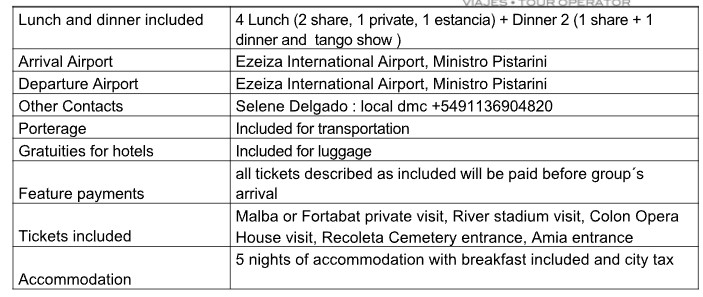
- Price per person on double basis: (2 people sharing a room) usd 2890.-
Price per person on single basis: (1 people per room- single occupancy) usd 3558.-
Suggested hotel: Melia Recoleta Boutique, Buenos Aires Grand or similar
Notes for Buenos Aires:
- Minimum group 20 people travelling together to consider those prices and
guarantee the group. We suggest to take an insurance in case of cancellation. - Booking process: please complete the booking form in case you want to join the
group and wait for our response before making the payment. - Payment Policy
- Initial Payment: 30% up to October 30 th – in order to guarantee the
minimum amount of travelers (20), This initial payment should be paid
before October 30 th – This initial payment is non reimbursable.
o Final payment: December 12 th – non reimbursable. Balance - Procedure: fill out this booking form and once we send you the confirmation,
we will request the payment. - Wire Payment info : Bank Of America
Beneficiary Primera Clase Corp .
Account Number 89809673158212 - ABA 026009593( domestic Wires )
*SWIF CODE *: BOFAUS3N ( International Wires )
Address
360 W 41 St
Miami Beach 33140
We do not accept credit cards.